Saturday, July 20, 2019

Healthy In-laws Relationships

Therefore shall a man leave his father and his mother, and shall cleave unto his wife: and
they shall be one flesh. (Genesis 2:24)

It’s such an important topic to talk about in-law relations because it can help couples learn how to manage their new life as a married couple, in-laws, and parents relations. I have witnessed difficulties in friend’s marriage due to in-laws and parents interference, and even divorces influenced by in-laws conflicts.
We can avoid many conflicts with in-laws and parents in our marriage, if we obey the commandment to “cleave unto his wife (her husband)”. But note that: 
“Elder Ashton reminded us that in cleaning to a spouse, married children should be faithful and supportive to their spouses, not not forget their parents. In turn, parents may need to give up previous roles their had with their children to allow the new couple to be independent. New husband and wives must recognize that their spouses still have relationships with their parents.” (Harper & Olsen, 2000, p. 327)
Related image

What if my parents and in-laws insist on having us to spend Thanksgiving and Christmas?
This is only one example that if the situation is well handled, it can avoid future conflicts in our marriage. In order to maintain a good relationship with in-laws and parents, couples should be careful in following three important points, according to President Kimball (Harper & Olsen, 2000, p. 328): 
  • Confide in and counsel with your spouse
It’s important to create rules with each other about things you can and cannot talk with others outside your marriage. It can avoid gossip and other conflicts within your extended family. This is part of their growth, and connection with each other. 
  • Establish your own household, separate from your parents
In marriage, couples have the opportunity to create their our rules and tradition, and it will be better achieved if they have their own home, not living in their parents home. I have found this to be one of my favorite parts when I was newly married because my family had traditions that I didn’t like. So I could change it, and create our own traditions.
  • Outside counsel should be considered prayerfully by both spouses together 
Whenever counsel the couple receive, the decision should be taken only the couple together, after they counsel each other. My husband and I used to refer this as creating our world. Our parents had their own world, and now we have our own world. Sometimes our parents and in-laws counsels would apply only to their lives, and not to our lives as married because we were different, we have created a different world from theirs.

Related image

References:
Harper, J.M., & Olsen, S.F. (2005). Creating healthy ties with in-laws and extended families. Salt Lake City, UT: Deseret Book Company.

Friday, July 12, 2019

Power Relation in Marriage

Families are vital for society and each individual. Inside this family association, there are innumerable opportunities to have good moments together, and create pleasant memories. There are also many challenges and some of these can be avoided if we have the right perspective. We can ask from any parent, or spouse if they had a moment of power struggle, and most will probably say they had.  Control, hierarchy, and power relations are crucial to help a family know how to deal with problems. 

“In healthy, well-functioning families, there is a clear hierarchy between parents and children. Parents are the “executive committee” and the “board of directors” of a family. As with any other leadership position, parents should not be harsh, domineering, or dictatorial, but they are the leaders of the family, and the children need to follow that leadership”.(Miller, 2008)

In order to make a power relations harmony work in families, couples relationship should be of partnership. Some principles will guide us into this direction:
  • Husbands and wives are equal.
  • Husbands and wives have different responsibilities, but they function as equals.
  • A husband’s role as patriarch gives him the responsibility to serve his wife and family.
  • Husbands and wives work together as partners.


  • What the world thinks

In the world today both man and woman are being flooded with the idea of being “the boss”. This approach will not help our families union, but repel each other. To handle challenges with unity and love, couples need to have respect and know that power means that we are to serve and love one another, instead of bossing around. There are traditions that teaches girls to submit themselves when they marry, and I remember I was given this idea too. Unfortunately boys are also taught they are to dominate not only girls, but any person that is below or different of them in someway.
  • What Jesus teaches
But Jesus Christ taught: “but whosoever will be great among you, let him be your minister; And whosoever will be chief among you, let him be your servant: Even as the Son of man came not to be ministered unto, but to minister, and to give his life a ransom for many (Matthew 20:25–28).”

It’s a joy to have a husband that understands his role and my role in the family, respects me, and talks to me so we can make decisions together. We are now teaching our children to control their ego, or natural man that makes us want to exercise dominion on others. Instead, we are teaching them to respect, serve, and  love one another because love doesn’t desire to control others. The harmony in our family is visible when we treat each other and our children with respect and love. I really feel we are one because of the way we approach power relation in our family.
Related image


References:

Miller, R. B. (2008). Who is the boss? Power relationships in families. BYU Conference on Family Life.  Provo, UT.


Saturday, July 6, 2019

Talking about Fidelity and Physical Intimacy

In the world, fidelity and physical intimacy is very different from Heavenly Father’s perspective. Couples could avoid problems caused by misunderstandings of physical intimacy and fidelity, if they were well taught at home by loving parents. 

Elder Barlow said: “Why does something so beautiful sometimes become a source of so many problems? Part of the difficulty stems from mistaken ideas. Some people still believe that sexual intimacy is a necessary evil by which we have children. These people get an inaccurate view from parents who were too embarrassed to discuss such matters with their children or who were so concerned that their children live the law of chastity that they taught only the negative consequences of the improper use of intimacy.”(Barlow, 1986)
When reading his quote, It was inevitable to remember my confusion about physical intimacy while growing up. In my childhood, it was common to see my parents arguing about their perspectives: reproduction x gratification. When I was older, I researched in Church books to learn what Heavenly Father thought about that. Gladly I was able to understand the purpose of physical intimacy before I married. But I wonder how many people have misconceptions about that and how it affects them, like it happened with my parents. So I would like to clarify some here:
1- Physical Intimacy does not comes from evil
When talking about physical intimacy, we should be careful to not pass the wrong message, especially to adolescents. Our intent to help our youth to wait until the right time of marriage covenant, can sometimes create an idea that physical intimacy is wrong or bad. Actually we should highlight that it comes from God, and as children don’t drive a car, physical intimacy should not be used outside of marriage covenant. 
 “The Bible celebrates sex and its proper use, presenting it as God-created, God-ordained, God-blessed. It makes plain that God himself implanted the physical magnetism between the sexes for two reasons: for the propagation of the human race, and for the expression of that kind of love between man and wife that makes for true oneness. His commandment to the first man and woman to be ‘one flesh’ was as important as his command to ‘be fruitful and multiply.’ ” (Billy Graham, Ensign, May 1974, p. 7.)
Image result for “Tenderness and respect–never selfishness–must be the guiding principles in the intimate relationship between husband and wife. Each
2- Physical intimacy vs submission
 “Ephesians 5:22 some have erroneously believed that this scripture means women are to submit or yield themselves to their husbands even if they do so unwillingly.”(Barlow, 1986)
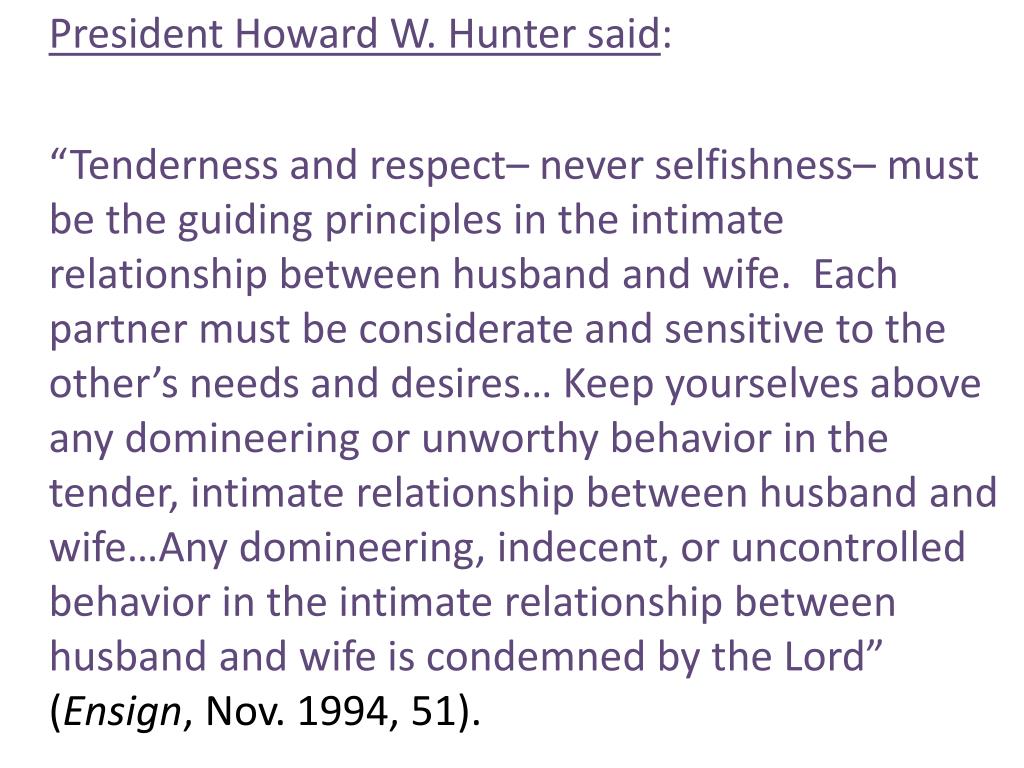
It seems hard to become one if women are forced by men, and men are discouraged to consider their wife feelings. But what we learn from modern prophets is that we should respect each other, and any act of selfishness is condemned by God, including in physical intimacy

3-The purpose of physical intimacy

I think Heavenly Father would not   gives us such strong power and   desire, if it was to be used only for   reproduction. It’s true that we are   commanded to be  fruitful and   multiply, and with physical   intimacy we are able to obey this   commandment. But also,   Heavenly  Father commanded   Adam and Eve to be one flesh. (Mark 10:8)
4- Pornography, physical intimacy, and fidelity
The use of pornography or other artifacts change the purpose of physical intimacy, and damage the couple relationship. The ability to feel close to each other through physical intimacy is destroyed, and fidelity is affected. The focus of pornography and infidelity is their own satisfaction, so it's based in selfishness and lust. These are not expression of love. 
Kimball.jpgWhunter.jpg

References:
Barlow, B.A. (1986). They twain shall be one: Thoughts on intimacy in marriage. Ensign, Sep 1986, 49.

Friday, June 28, 2019

A matter of perspective

“Understanding the nature of conflict leads to peace."(Lester B. Pearson)

Conflict in marriage are expected and usually happens when couples disagree, but there are disagreements that are really hard to be solved. Couples usually don’t realize the profound meaning of some behavior and decisions they make, until their spouse show a different perspective regarding her/his attitude. They feel their opinion or behavior is threatened, instead of respected and valued. 


Dr Gottman, author of "The Seven Principles For Making Marriage Work", called these unresolved conflict gridlock, and he said: “Keep working on your unsolvable conflicts. Couples who are demanding of their marriage are more likely to have deeply satisfying unions than those who lower their expectations.” 


Here are some exercises that can help you overcome gridlock: 
  • Become a “Dream Detective” - Allow yourself to contemplate dreams you may have buried or ignored within the gridlocked issue. This will help you to understand the ways in which you feel that these wishes are not being addressed in your relationship.
  • Explain your position to your partner without criticism or blame - “Come to an understanding of the dreams that you and your mate have within the conflict, and dig deeper than the superficial issue to discover your feelings and hopes below the problem at hand. Suspend judgment. Relax. Give each other time, and do not attempt to solve the problem immediately. Ask questions!”
  • Soothe each other - If you feel like you are becoming flooded with emotion, or incapable of productive conversation, take a break either alone or with your partner. If your heart rate exceeds 100 beats per minute, you won’t be able to hear what your spouse is trying to tell you no matter how hard you try.”
  • Accept that some problems are unsolvable “your purpose is not to solve the conflict – it will probably never go away completely… instead the goal is to ‘declaw’ the issue, to try to remove the hurt so the problem stops being a source of great pain.” 

In overall, learning how to accept and respect each other is the key to solve conflict and enrich our marriage, according to Dr. Gottman. But I was to link his idea to Goddard's advice in one word: Charity.
"We are all familiar with the lack of charity. We have all felt the critical, negative, carping, nit-picking, fault-finding, and grousing attitude that comes easily to the natural man. Charity does not flow automatically from having an extraordinary spouse. It is primarily the result of the way we choose to see each other. " (Goddard, 2009, p. 119)
In my experience, the more I see my husband as a son of God, the more my love and respect for him increase and our conflicts  become less and less difficult to be solved. Not that we don't disagree anymore, but it don't matter as much as our love for one another. "He" is more important than "me", and vice versa.
                                                                       
 (Links to an external site.
References:
Gottman, J. M., & Silver, N. (2015) The seven principles for making marriage work. New York, NY: Harmony Books.
Goddard, H.W. (2009) Drawing heaven into your marriage. Cedar Hills, UT: Joymap Publishing.

Saturday, June 22, 2019

Sacrifice in Marriage

“It is twice blest: It blesseth him that gives and him that takes.” (Shakespeare, The Merchant of Venice)
People have different perspectives and ideas, and naturally in marriage these differences will happen. Couples differences can go from where to place a frame, to housecleaning and the way they treat each other.  Goddard said:”We enter marriage expecting our needs to be met. We even decide how they should be met. Then, when our partners are unable to meet all of our needs, we become resentful.” (Goddard, 2009, p.106).
Image result for sacrifice in marriage
What happens is that our resentment escalates, and this conflict becomes a problem. Dr Gottman  described three types of problems, in his book “The Seven Principles to Make Marriage Work”:
  • Solvable problems can be about housecleaning, disciplining children, sex, and in-laws. Solvable problems for one couple can be about the exact same topics that could be perpetual problems for a different couple. A solvable problem within a relationship is about something situational. The conflict is simply about that topic, and there may not be a deeper meaning behind the each partner’s position. A solution can be found and maintained. (Gottman, 2015)
  • Perpetual problems are problems that center on either fundamental differences in your personality, or fundamental differences in your lifestyle needs. All couples have perpetual problems. These issues can seemingly be about the exact same topics as what for another couple might be solvable; however, unlike a solvable problem, these are the problems that a couple will return to over and over and over again. (Gottman, 2015)
  • Gridlocked perpetual problems are perpetual problems that have been mishandled and have essentially calcified into something “uncomfortable.” When a couple tries to discuss a gridlocked issue, it can feel like they are “spinning their wheels” and getting nowhere. The nature of gridlock is that hidden agendas underlie the issue. (Gottman, 2015)       
Image result for seeing each other perspective

One of the beauties of marriage is when two different people manage to see each other's perspective, and continue to respect and love one another. I have learned that showing my husband that he is loved and accepted makes easier to talk about hard issues in our relationship.  Besides that listening to each other perspective and respecting these perspectives will not necessarily solve problems, but it will open space to understanding and collaboration.  Goddard mentioned that in James Farrell's book, The Peacegiver, “shows that most of our discontents are caused by our shriveled, narrow views of our partners.” (Goddard, 2009, p.106)


Intelligent couples turn their disagreements into an opportunity to connect them. Here it is how they do it, and some suggestions to avoid conflicts when there is disagreements.
Intelligent couples:
Avoiding conflicts:
1- Soften their start-up conversations;
  • Complain but don’t blame: “I feel…; About…;What?...; and “I need…”
2- Learn to make and receive repair attempts during a discussion;
  • Make statements that start with “I” instead of “You”.
3- Soothe themselves and their spouse;
  • Describe what is happening. Don’t evaluate or Judge.
4- Compromise;
  • Be clear about your positive need.
5- Process any grievances so that they don’t linger.
  • Be polite.
  • Be appreciative about good things done by your spouse.
  • Don’t store things up.


References:
Gottman, J. M., & Silver, N. (2015) The seven principles for making marriage work. New York, NY: Harmony Books.
Goddard, H.W. (2009) Drawing heaven into your marriage. Cedar Hills, UT: Joymap Publishing.

Saturday, June 15, 2019

Humility in Marriage

“...unless we yield to the enticings of the Holy Spirit and put off the natural man and  becometh as children-submissive, meek, humble, patient, full of love, willing to submit to all things…”(Mosiah 3: 19)
Image result for humility in marriageA long-term study of 130 newlywed couples found that husbands emotionally intelligent had happier marriage, because they allowed themselves to be influenced by their wives.(Gottman, 2015, p.116) Even though it seems to be harder for men be influenced in marriage, when they allow their wives to influence them, their marriage relationship improves. “Because this type of husband honors and respects his wife, he will be open to learning more about emotion from her...He may not emote in the same way that his wife does, but he will learn how to better connect with her emotionally.”(Gottman, 2015, p.123) 
It reminded that of The Family Proclamation to the World: “ALL HUMAN BEINGS—male and female—are created in the image of God. Each is a beloved spirit son or daughter of heavenly parents, and, as such, each has a divine nature and destiny.”
Men and women have a divine nature and destiny, which unique characteristics help them exercise their role. But it does not mean that they cannot learn from one another to develop other abilities. Like husband can learn with their wives how to be more sensitive with others, and wives can learn the ability to listen and control stress with their husbands.
Being open to learning is a great way to develop friendship and strength a couple relationship. But often, what stay in a way for happy and stable marriages is pride.
So Dr Gottman and Goddard suggests some practices to help couples be humble:
  • Turning to God in faith and repentance is the cure for pride and self-centeredness. We can leave the relationship, smolder in sullen resentment, or repent. Repentance "denotes a change of mind, i.e., a fresh view about God, about oneself, and about the world. (Goddard, 2009)
  • Perhaps the fundamental difference between husbands who accept influence and those who don't is that the former have learned that often in life you need to yield in order to win. (Gottman, 2015, p.125)
Sometimes couples seem to be in a competition of who is right and wrong. Who will be the winner? If there is a loser and winner, so marriage loses. When we are humble to accept each other influences, then we both win because we are one!


Image result for humility in marriage

References
Gottman, J. M., & Silver, N. (2015) The seven principles for making marriage work. New York, NY: Harmony Books.
Goddard, H.W. (2009) Drawing heaven into your marriage. Cedar Hills, UT: Joymap Publishing.

Saturday, June 8, 2019

Turning toward one another


Related image
"Great things are done by a series of small things brought together. " (Vincent Van Gogh)
See Van Gogh image here

          This quote from Vincent Van Gogh reminds me of his impressive paintings. Interestingly, his works only became impressive after a process of individual paint, brushwork, hours of dedication, and a lifetime of struggles and experiences. As small and single elements turn into beautiful pictures, similarly small actions of couples establishes strong marriages.
          At least it’s what Dr Gottman found in healthy and emotionally intelligent couples, which he says are “always making “bids” for each other attention, affection, humor, or support”.(Gottman, 2015)
         Bids are little ways of drawing attention, and when these bids are answered the couple turn toward one another through positive and small interactions, verbal or not verbal, which connects them emotionally.

  • What are these little ways in which you stay connected by turning toward your spouse close to you? 
       Incredibly, we don’t need to spend a lot of money or do big things to connect  in our marriage. Listening to your husband after a long day of work, helping your wife doing household chores, a hug or kiss, saying “I love you” are some examples.

  • What impact do these little actions have on your relationship?
      “Being helpful to each other will do far more for the strength and passion of your marriage than a two-week Bahamas getaway.”(Gottman, 2015)“In our six-year follow-up of newlyweds, we found that couples who remained married had turned toward their partner’s bids an average of 86 percent of the time in the Love Lab, while those who ended up divorced had averaged only 33 percent.”(Gottman, 2015)
        Little actions will strength couples more than they think. It will help them develop a relationship of trust, love, and unity. Besides that, a couple with more positive interactions than negative will more likely be able to overcome challenges that will surely come.

Related image       Naturally, connecting to each other is not always simple and easy as we think. There are some challenges we should be aware of, but these two are the most common: receiving the bid as criticism or defensiveness, or being distracted with digital devices when receiving a bid. 

       From my experience, these challenges are common and can disrupt our connection. I have learned that something we can do to respond to these challenges is having an attitude of care toward our spouse. 
Here are other ways we can connect with our spouse:

  • Remember that your spouse complaints can be a need for attention;
  • Listen to your spouse, instead of using devices;
  • Dedicate your time to your spouse;
  • Show affection in moments of stress;
  • Use words of empathy and encouragement during hard times;
  • Try to understand how your spouse feel, instead of giving solutions.


References

Gottman, J. M., & Silver, N. (2015) The seven principles for making marriage work. New York, NY: Harmony Books.